Build the foundations
Wire circuits, read sensors, control outputs, and learn how to debug. Make the engineering notebook part of the daily routine.
Arduino · Electronics · C/C++THE CLASSROOM IS A WORKSHOP.
AI & Mechatronics connects code, circuits, and machine learning with things students can actually build.
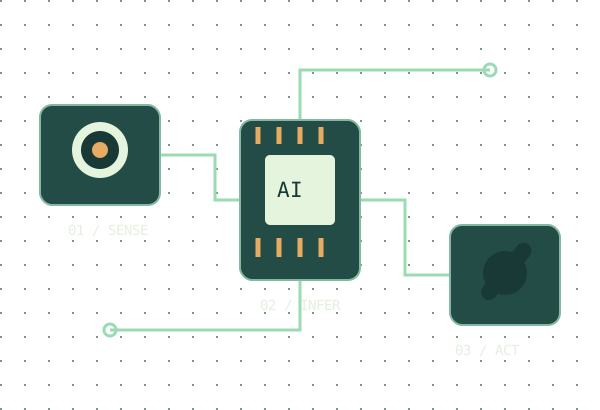
A system diagram, not a wiring guide.
LEARN BY MAKING
Students learn to connect an input to a decision and a physical response. Along the way, they solder, debug, collect data, train or deploy models, and explain the engineering choices behind a prototype.
AIM builds on the earlier Mechatronics Project Laboratory course, expanding the learning pathway into TinyML, embedded vision and audio, motion classification, and language models on edge devices.
THE LEARNING PATHWAY
Wire circuits, read sensors, control outputs, and learn how to debug. Make the engineering notebook part of the daily routine.
Arduino · Electronics · C/C++Move into the Raspberry Pi desktop, terminal, and Python. Integrate displays, clocks, and environmental sensors.
Raspberry Pi · Python · FabricationCollect images for JetBot, explore TinyML on small boards, and connect model predictions to a useful response.
Computer vision · Audio · Edge AIPropose, pitch, prototype, test, and present an independent capstone. Explain what changed and what still needs work.
Design · Teamwork · CommunicationFOUR WAYS TO MAKE AI TANGIBLE
Explore the AI strands in the course. Select one to see how input becomes a response.
Illustrative learning pathways, not live model predictions. Edge language models run on more capable devices such as Raspberry Pi, not necessarily a microcontroller.
Students used a SenseCraft rock–paper–scissors model with the XIAO ESP32S3 Sense.
FROM THE STUDENT WORKBENCH
Selected 2025–2026 projects, summarized anonymously from classroom accounts and final narratives.
A camera and a SenseCraft gesture model recognize the player’s hand. Game logic connects the result to a servo-driven pie mechanism.
Connecting a pretrained model to game logic and mechanical action.
A Raspberry Pi device listens after a button press, transcribes speech, extracts a quantity and unit, and converts the result.
Integrating models and code; refining the scope to fit the available time.
An electronic game combines an LED matrix, joystick, controls, and displays. The team replaced an ambitious mechanical design with an achievable electronic one.
Managing complexity and making a design change. This is an electronics project, not an AI claim.
Buttons position the arm while a color sensor and Arduino trigger a servo grip. The team moved on from an initial AI-drone concept; gripping reliability remained a limitation.
Separating manual control, sensor logic, and mechanical reliability.
BUILT IN ONE CLASSROOM. SHARED WITH YOURS.
Browse editable handouts, teaching outlines, the syllabus, and the resources that helped shape AIM.